

When you decide to buy sauna for your backyard, you're not just adding a structure. You're committing to a wellness practice, a design statement and a piece of equipment that will perform for decades if chosen carefully. North American homeowners often approach this purchase the same way they'd research a hot tub, deck or outdoor kitchen: by comparing specifications, understanding trade-offs and matching the product to their specific site, climate and household. The difference is that outdoor saunas carry a deeper tradition. In Finland, where sauna culture is woven into daily life, the questions aren't about features or fads. They're about heat quality, material longevity and the rituals you'll build around the practice. This guide walks through the decisions that matter most when you buy sauna, helping you move from interest to a confident choice.
Understanding What You're Actually Buying
When you buy sauna, you're acquiring three things at once: a climate-controlled structure, a heating system and a set of interior components designed to work together. Many first-time buyers assume the sauna is the cabin alone. In reality, the heater, bench material, ventilation design and wall assembly all influence performance.
A typical outdoor sauna package includes:
- Wall panels (log-style interlocking or modular)
- Roof structure with shingles or seam roofing
- Tempered glass door and windows
- Interior benches (alder, aspen or other heat-tolerant wood)
- Floor joists or base platform
The heater is almost always sold separately. This gives you flexibility to choose electric or wood-burning heat, but it also means you need to plan electrical service or venting at the same time you're selecting the cabin. If you're comparing models and one lists "heater included," confirm the type, brand and capacity. Many budget kits include an undersized or non-certified heater that requires replacement before the first session.
Why Material Choice Defines Long-Term Value
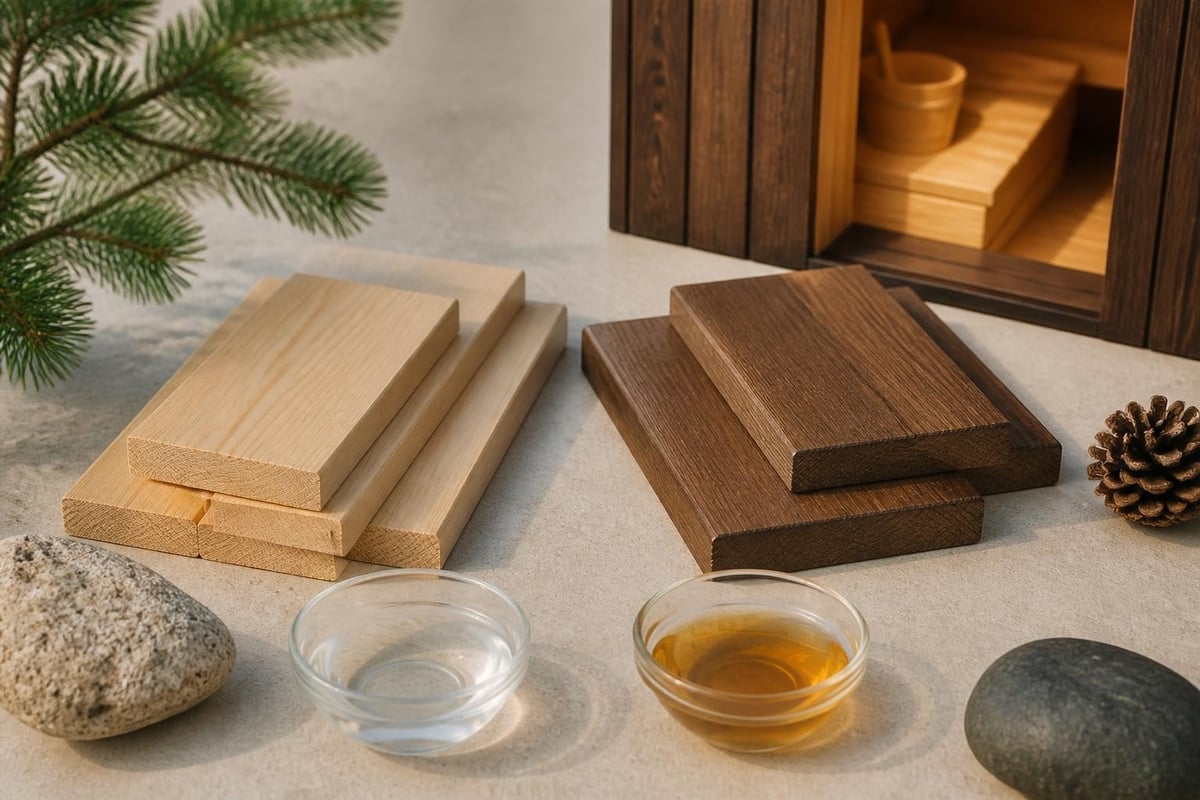
The two most common wall materials in premium outdoor saunas are Nordic Pine and Thermowood. Both are solid softwoods, but they behave very differently over years of outdoor exposure.
Nordic Pine is untreated, light in color and less expensive. It's a strong choice if you plan to stain or seal the exterior and you're comfortable with seasonal maintenance. Over time, unfinished pine will gray naturally, similar to cedar fencing. Regular treatment slows moisture absorption and minimizes checking.
Thermowood is heat-treated to reduce moisture content and improve dimensional stability. The process darkens the wood to a rich brown and significantly extends durability in wet or freeze-thaw climates. Thermowood resists warping, mold and insect damage better than untreated softwoods, making it the preferred choice for year-round North American installation without exterior finish. When you compare outdoor sauna cost, Thermowood models typically carry a higher upfront price, but the reduction in long-term maintenance often justifies the premium.
Sizing the Sauna to Your Household and Space
Sauna capacity is usually expressed as a person count, but that metric is only useful if you know how manufacturers define it. A "4-person sauna" often assumes two people seated on the upper bench and two on the lower, with minimal elbow room. If you want to lie down, stretch out or sauna with kids, you need more interior length and bench depth.
Common outdoor sauna footprints and realistic capacity:
| Exterior Size (m) | Interior Area (m²) | Realistic Capacity | Best For |
|---|---|---|---|
| 2.0 × 2.0 | ~3.0 | 2 seated | Solo or couple, compact yards |
| 2.3 × 2.3 | ~4.2 | 2–4 seated, 1 lying | Small families, limited space |
| 3.0 × 2.3 | ~5.4 | 4–6 seated, 2 lying | Multi-person households, entertaining |
| 3.0 × 3.0 | ~7.0 | 6+ seated, 3 lying | Large groups, commercial-style use |
When you buy sauna, measure the site carefully. Most buyers focus on footprint but forget clearance. You'll need access to all four sides for assembly, maintenance and eventual re-staining. Plan for at least 0.5 m clearance on three sides and 1.0 m on the entry side for a small patio or step. If your site slopes, budget for a gravel pad, concrete piers or a treated-wood platform to create a level base. Uneven foundations cause door misalignment and stress on log joints.
Bench Layout: Straight vs L-Shaped
Bench configuration changes how the sauna feels and functions. A straight bench runs along one wall, maximizing lying-down length. An L-shaped bench wraps two walls, adding seated capacity but reducing flat space. Most traditional Finnish home saunas use a two-tier straight bench on the back wall, leaving the side walls open or fitted with a narrow lower step.
If you primarily sauna alone or with one other person and value the ability to fully recline, choose straight benches. If you host groups or prefer face-to-face seating, the L-shaped layout works better. Both layouts support authentic löyly and heat circulation when paired with the right heater placement.
Heater Selection: Electric vs Wood-Burning
The heater is the heart of the sauna, and it's the single component you cannot change easily later. When you buy sauna, decide on heat source early, because it dictates electrical planning, ventilation design and ongoing operating cost.
Electric heaters are the default choice for most North American buyers. They're cleaner, easier to install and compatible with programmable controls and timers. A properly sized electric sauna heater (typically 6–9 kW for a 5–7 m² cabin) heats the room to 80–85°C in 30–45 minutes. Installation requires a dedicated 240V circuit, a disconnect switch and compliance with local electrical codes. Many jurisdictions now reference IEC 60335-2-53, the international safety standard for electric sauna heating appliances, as part of their inspection process. The recent transition to UL 60335-2-53 in the United States reflects updated safety requirements, so confirm that any heater you're considering carries current UL or ETL certification.
Wood-burning heaters deliver traditional ambiance and higher peak temperatures (often 90–100°C). They require a chimney, roof penetration and clearance from combustible surfaces. Operating cost is lower if you have access to firewood, but you'll spend 10–15 minutes tending the fire and managing airflow during each session. Wood heat is the right choice if you value ritual, off-grid capability or the sensory experience of fire. It's a poor fit if convenience, consistent temperature or indoor air quality are priorities.
Year-Round Performance in Cold Climates
A common question when buyers research outdoor saunas is whether the cabin will function through a Canadian or northern U.S. winter. The short answer is yes, but performance depends on wall thickness, roof insulation and heater capacity.
Most premium log-style outdoor saunas use 46 mm solid-wood walls. This provides reasonable thermal mass and moderate insulation (approximately R-2 to R-3). In temperatures down to -20°C, a correctly sized electric heater will reach target temperature, but heat-up time increases and heat loss accelerates when you open the door or throw water on the stones. If you sauna frequently in deep winter, consider a model with an insulated roof or add a foil-backed blanket insulation layer between the roof boards and shingles.
Thermowood construction improves winter performance not because of insulation value, but because the material resists freeze-thaw cycling and maintains tighter joints. When Nordic Pine absorbs moisture and freezes, small gaps can open at log interfaces, increasing drafts. Thermowood's lower moisture content minimizes this seasonal movement.
Ventilation in Enclosed Winter Saunas
Proper ventilation becomes critical when you buy sauna for year-round use. Outdoor saunas typically rely on passive air exchange: fresh air enters low (under the heater or through an adjustable vent) and warm, moist air exits high (through a roof vent or chimney). In winter, many owners close all vents to retain heat. This slows heat loss but also traps carbon dioxide and moisture, reducing comfort and increasing mold risk.
Best practice is to maintain continuous low-level ventilation even in winter. A 10–15 cm² fresh-air inlet and a 20–25 cm² outlet keeps oxygen levels comfortable without significant heat loss. For technical guidance on ventilation rates and air quality in enclosed heated spaces, the ASHRAE position documents provide authoritative benchmarks, though they focus on commercial applications. Scale the principles to your cabin size and session frequency.
Changing Room and Terrace Options
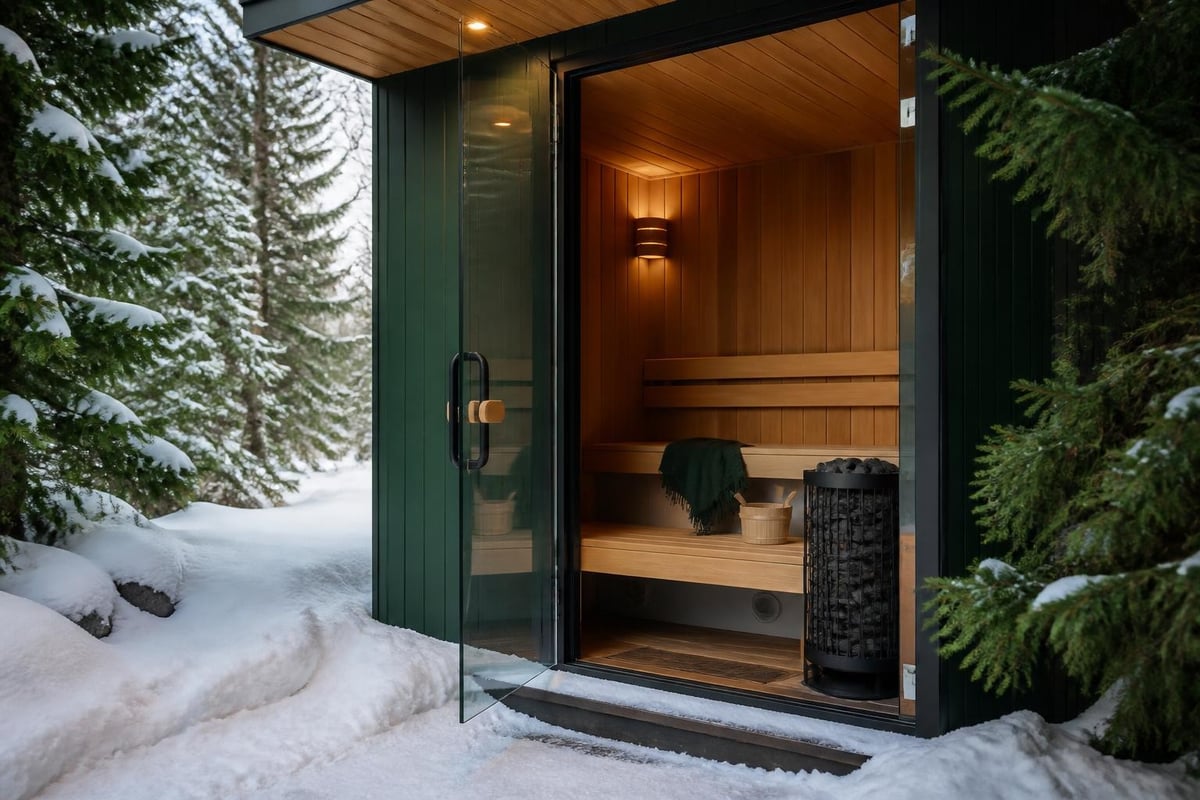
When you buy sauna, consider how you'll transition in and out. Walking directly from the hot room into cold air is invigorating in summer, but in winter or rainy weather, a changing area or covered terrace adds comfort and practicality.
Changing room: A dedicated interior space (typically 1.0 m deep) with a bench, hooks and a second door separating it from the sauna chamber. This allows you to undress, store towels and cool down without stepping outside. Changing rooms also serve as an airlock in winter, reducing heat loss when someone enters or exits. If you have young children, a changing area gives you space to supervise and prepare before opening the sauna door.
Terrace: An open covered deck attached to the sauna entry. Terraces don't offer privacy but they extend your usable footprint and create a transition zone for relaxation between rounds. Many buyers pair a terrace with a cold plunge, outdoor shower or seating area, building a complete backyard wellness circuit.
If space and budget allow, a changing room adds the most value in climates with significant winter or shoulder-season use. Terraces work best in mild or seasonal climates where you'll spend time outdoors before and after the sauna.
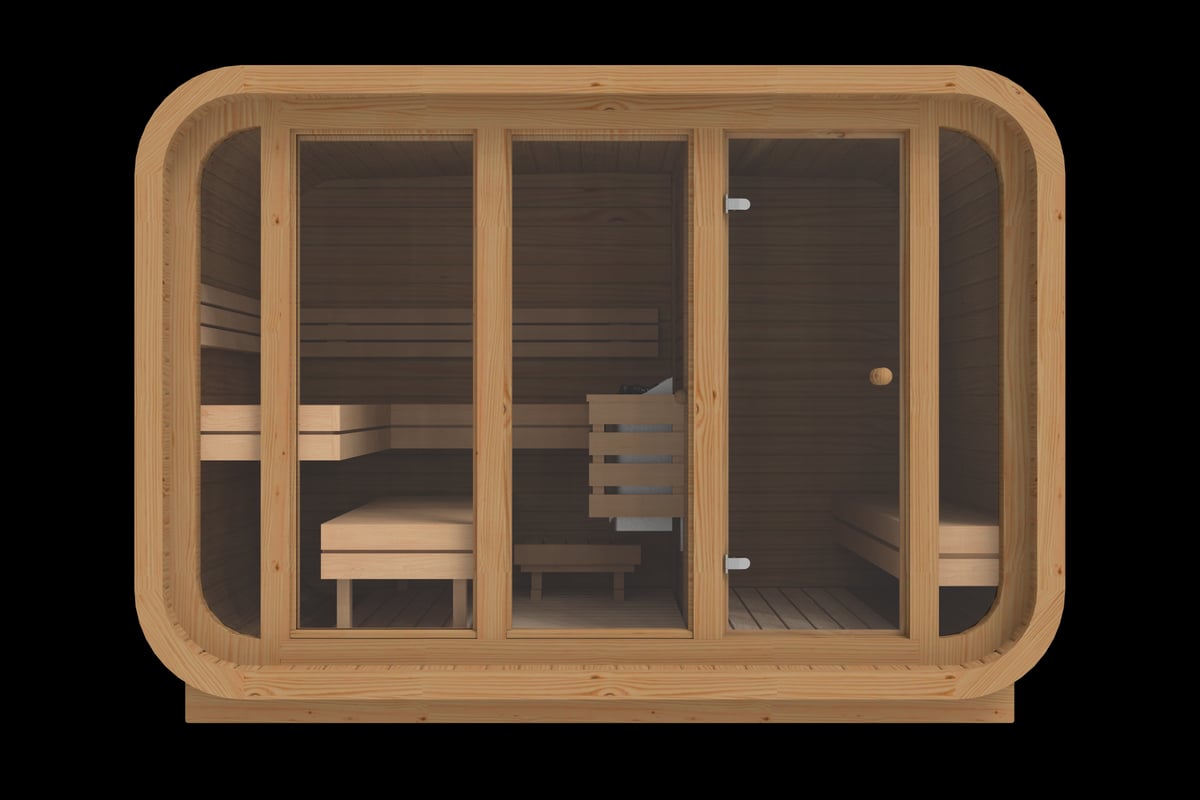
One model that integrates a changing room and full sauna chamber in a single efficient footprint is the RecoSauna Comfort Square Sauna 3.0 × 2.3 m in Thermowood. With 46 mm Thermowood walls, four tinted windows and a 1 m changing room separated by an internal glass door, it delivers both privacy and year-round durability without requiring a separate structure.
Foundation and Site Preparation
You cannot buy sauna and set it directly on soil or grass. Outdoor saunas require a stable, level, moisture-resistant foundation. The three most common approaches are gravel pads, concrete slabs and treated-wood decks.
Gravel pads are the simplest and least expensive. Excavate 15–20 cm, lay landscape fabric, fill with crushed stone and compact in layers. Top with concrete pavers or treated timbers to create a level platform. Gravel drains well and allows minor adjustments during installation, but it's not suitable for sloped sites or areas with poor drainage.
Concrete slabs offer the most stability and longevity. Pour a 10 cm slab with rebar and a vapor barrier, ensuring it extends 10–15 cm beyond the sauna footprint on all sides. Concrete is ideal for permanent installations, but it's more expensive and requires lead time for curing. If you plan to add a cold plunge or outdoor shower, pour the slab large enough to accommodate future expansion.
Treated-wood decks work well if you're installing the sauna as part of a larger outdoor living area. Use pressure-treated framing and composite or treated decking rated for ground contact. Ensure joists are spaced at 40 cm on-center to support the sauna's weight (typically 800–1,200 kg when assembled). Elevating the sauna on a deck improves drainage and simplifies snow clearance in winter.
For more detail on foundation options and cost considerations, refer to our guide on square outdoor saunas, which covers site preparation across multiple climates and terrain types.
Comparing Models: What to Look For
When you're ready to buy sauna, create a comparison table of the top two or three models you're considering. Focus on specifications that directly affect performance, durability and fit.
| Feature | Model A | Model B | Model C |
|---|---|---|---|
| Wall material | Nordic Pine | Thermowood | Thermowood |
| Wall thickness | 46 mm | 46 mm | 40 mm |
| Interior area | 4.2 m² | 5.4 m² | 3.8 m² |
| Bench layout | Straight | L-shaped | Straight |
| Windows | 2 tinted | 4 tinted | 1 clear |
| Changing room | No | Yes (1.0 m) | No |
| Heater compatibility | Electric / wood | Electric / wood | Electric only |
| Roof insulation | None | None | Insulated |
| Glass door thickness | 8 mm | 8 mm | 6 mm |
Pay attention to what's not included. Many models ship without the heater, rocks, floor insulation or exterior stain. Confirm delivery method (curbside, liftgate or inside delivery), assembly requirements (DIY-friendly or professional recommended) and lead time. Most North American outdoor sauna suppliers ship from regional warehouses, with typical delivery in 2–6 weeks depending on model and season.
Red Flags When Shopping
- No material specification: If the listing says "premium wood" or "cedar-style" without naming the species, ask. Cheap imports often substitute lower-grade softwoods or mixed species.
- Heater included, brand unspecified: Bundled heaters are sometimes off-brand units that lack UL/ETL certification or proper capacity for the cabin size.
- "Lifetime warranty" without details: Legitimate warranties specify coverage (structure, door, hardware) and duration for each component. Vague promises are unenforceable.
- Price too low for claimed features: A 3 × 3 m solid-log Thermowood sauna should not cost the same as a 2 × 2 m Nordic Pine cabin. If it does, something is misrepresented.
Installation: DIY or Professional
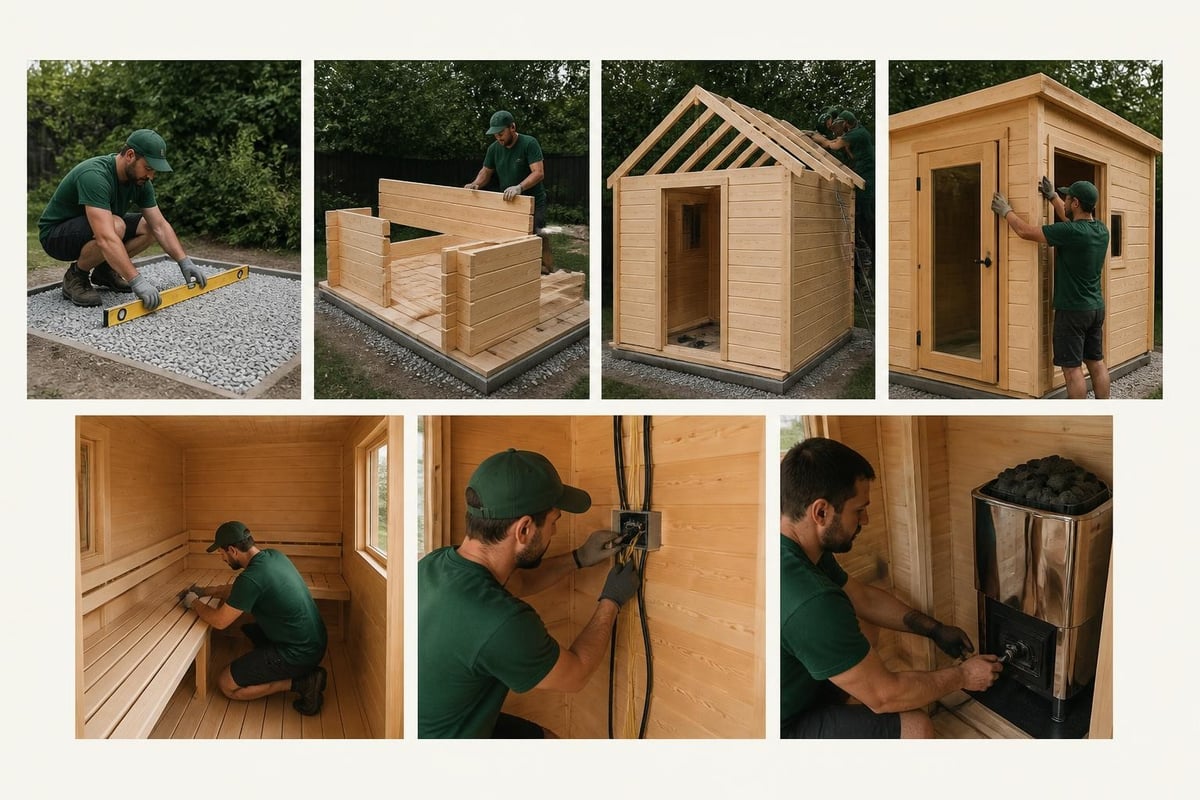
Most outdoor barrel and square saunas are designed for homeowner assembly. Manufacturers ship the cabin as pre-cut log or panel sections with numbered pieces, hardware bags and illustrated instructions. Two people with basic carpentry skills and common tools (drill, level, ladder, socket set) can typically assemble a small to mid-size sauna in one to two days.
DIY makes sense if:
- The foundation is already prepared and level
- You have help (saunas are awkward to lift and align solo)
- You're comfortable reading technical instructions and adjusting tolerances
- You plan to hire an electrician separately for heater wiring
Professional installation is worth considering if:
- The site requires grading, drainage work or a poured foundation
- Local codes require licensed contractors for structures over a certain size
- You're installing electric service and want one contractor to handle both cabin and wiring
- You're buying a large or complex model (e.g., with terrace, insulated roof or custom layout)
Even if you assemble the cabin yourself, hire a licensed electrician for the heater circuit. Sauna heaters draw significant current (typically 30–50 amps at 240V) and improper wiring creates fire and shock hazards. The permit and inspection process also ensures your installation meets local codes, which protects resale value and insurance coverage.
Pairing Sauna with Cold Plunge
Many buyers who decide to buy sauna also plan to add a cold-plunge tub or shower. Contrast bathing (alternating hot and cold exposure) has roots in Finnish and Scandinavian traditions and is increasingly popular in North American wellness circles. Research on sauna bathing and inflammation suggests that regular heat exposure may support cardiovascular health and stress recovery, though individual results vary and the practice is not a substitute for medical treatment.
If you're planning a sauna-plunge setup, design the site layout with both in mind. Ideal spacing is 2–4 meters between the sauna door and plunge edge, close enough for quick transitions but far enough to avoid splashing or drainage conflicts. Locate the plunge downhill from the sauna to simplify runoff management.
Cold-plunge options:
- Stock tanks (affordable, portable, no plumbing required)
- Pre-fabricated fiberglass tubs (insulated, with optional chiller)
- Custom-built concrete or tile plunges (permanent, integrated into landscaping)
- Outdoor showers (low-cost alternative for cold rinse)
If winter use is a priority, consider a plunge with a heater or circulation pump to prevent freezing. Alternatively, drain the tub after each session and refill from a hose before your next sauna. This adds setup time but eliminates the need for insulation or mechanical systems.
For homeowners who value integrated design, some outdoor living spaces now combine sauna, plunge and covered seating into a single wellness courtyard. If that vision appeals, it may be worth consulting a landscape designer or home-cinema specialist like ANR Media, who can help coordinate lighting, sound, automation and climate control across multiple zones.
Financing and Budget Planning
Outdoor saunas range from around $4,000 for a basic 2-person cabin to $20,000+ for large insulated models with changing rooms, terraces and premium finishes. When you buy sauna, plan for the total installed cost, not just the cabin price.
Typical cost breakdown:
- Sauna cabin: $5,000–$15,000
- Electric heater and rocks: $600–$1,500
- Electrical service (circuit, panel upgrade, permit): $800–$2,500
- Foundation (gravel pad or slab): $300–$2,000
- Assembly labor (if hiring): $1,000–$3,000
- Accessories (thermometer, bucket, ladle, headrests): $100–$300
If the upfront cost is a barrier, many sauna retailers offer financing through third-party providers. Terms vary, but 12–24 month zero-interest promotions are common for buyers with good credit. Review the financing options offered by your chosen supplier and confirm whether the promotional rate applies to the full purchase (cabin plus heater and accessories) or the cabin alone.
Maintenance and Longevity
A well-built outdoor sauna should last 15–25 years with routine care. The two largest maintenance tasks are exterior wood treatment and heater rock replacement.
Exterior care: If you buy sauna in untreated Nordic Pine, plan to apply a water-repellent stain or wood oil every 2–3 years. Thermowood can be left natural (it will weather to a silver-gray patina) or treated to preserve the original brown color. Clean the roof and gutters annually to prevent moss and debris buildup.
Interior care: Wipe benches after each session to remove sweat and moisture. Once or twice a year, scrub benches with a mild wood cleaner or sand lightly to remove stains. Avoid harsh chemicals or sealers inside the cabin, as they release fumes when heated.
Heater maintenance: Replace sauna rocks every 1–2 years (more often if you sauna daily). Cracked or crumbling rocks reduce heat retention and can clog the heater element. Check the heater thermostat and high-limit switch annually. Most electric heaters have a service life of 10–15 years; wood stoves last longer but require chimney cleaning and gasket replacement.
How to Move from Research to Purchase
By this point, you've narrowed your choices based on size, material, layout and budget. The final step is to confirm delivery, installation support and warranty terms before you buy sauna.
Before placing the order:
- Verify product availability and lead time
- Confirm what's included (cabin, floor, roof, glass, benches) and what's sold separately (heater, rocks, finish, assembly)
- Review shipping method and whether the carrier will deliver to your specific address (some rural or steep-access sites incur extra fees)
- Ask about return policy and damage claims (most saunas ship freight and require inspection at delivery)
- Check warranty coverage for structure, glass and hardware
Request a copy of the assembly manual before delivery. This lets you review the process, order any special tools and line up help for installation day. If you're hiring a contractor, share the manual with them so they can provide an accurate quote and timeline.
For more detailed guidance on the purchase process and what to expect, visit RecoSauna's blog, where you'll find articles on model comparison, installation and year-round operation.
Regional Considerations Across North America
Building codes, electrical standards and climate vary significantly across the United States and Canada. When you buy sauna, confirm that the model and installation plan align with your local requirements.
United States: Most jurisdictions treat outdoor saunas as accessory structures. Depending on size and location (setback from property lines), you may need a building permit. Electrical work almost always requires a permit and inspection. Heater certification (UL or ETL) is typically mandatory. Some HOAs restrict outbuilding size, color or placement, so check covenants before ordering.
Canada: Provincial and municipal codes govern sauna installation. Electrical requirements are similar to the U.S., but some provinces mandate additional insulation or vapor barriers for year-round structures. In cold-climate zones (e.g., Alberta, Saskatchewan, northern Ontario), confirm that the sauna's wall thickness and roof design meet local energy or weatherproofing standards.
In both countries, coastal and high-humidity regions benefit from Thermowood construction and corrosion-resistant hardware (stainless or galvanized). Arid climates can use Nordic Pine with less concern about rot, but UV exposure accelerates fading, so exterior stain or shade placement helps preserve appearance.
Choosing the right outdoor sauna starts with understanding how size, material, heating and layout shape daily use and long-term satisfaction. When you buy sauna with a clear sense of your site, climate and household needs, you're investing in a practice that supports wellness, connection and tradition. RecoSauna brings Finnish sauna expertise to North American backyards, offering Thermowood and Nordic Pine models designed for year-round performance, authentic löyly and straightforward installation. Explore our collection and start building your backyard sauna plan today.
Share:
Luxury Outdoor Sauna: Design, Materials & Buying Guide
Contrast Therapy Benefits: Sauna & Cold Plunge