

An electric sauna offers North American homeowners a practical, code-compliant path to authentic Finnish sauna bathing without the chimney, ash cleanup or wood storage that comes with traditional wood-burning stoves. Electric heaters bring sauna rocks to proper löyly temperature in 30 to 45 minutes, operate on standard 240-volt household circuits and meet stringent UL and CSA safety standards enforced across the USA and Canada. For buyers planning a backyard sauna, understanding heater sizing, electrical installation, operating costs and the subtle performance trade-offs between electric and wood heat will shape your long-term satisfaction and investment value.
Why Choose an Electric Sauna Heater
Electric sauna heaters dominate the North American residential market because they satisfy local building codes, integrate cleanly into modern outdoor saunas and eliminate the permitting hurdles that often accompany wood-burning installations.
Code Compliance and Safety Certification
Every electric sauna heater sold in North America must carry UL or CSA certification, confirming compliance with IEC/EN 60335-2-53 and NFPA 70 (National Electrical Code) installation requirements. This certification process validates heater construction, thermal cutoffs, grounding, rock-chamber design and clearance distances to combustible materials.
Key regulatory advantages:
- No chimney inspection or masonry work required
- Simpler permitting in most jurisdictions (electrical permit only)
- Lower homeowner liability and easier insurance approval
- Factory-tested thermal controls reduce fire risk
Many municipalities restrict or prohibit wood-burning appliances due to air quality rules. Electric heaters sidestep those restrictions entirely.
Installation Speed and Convenience
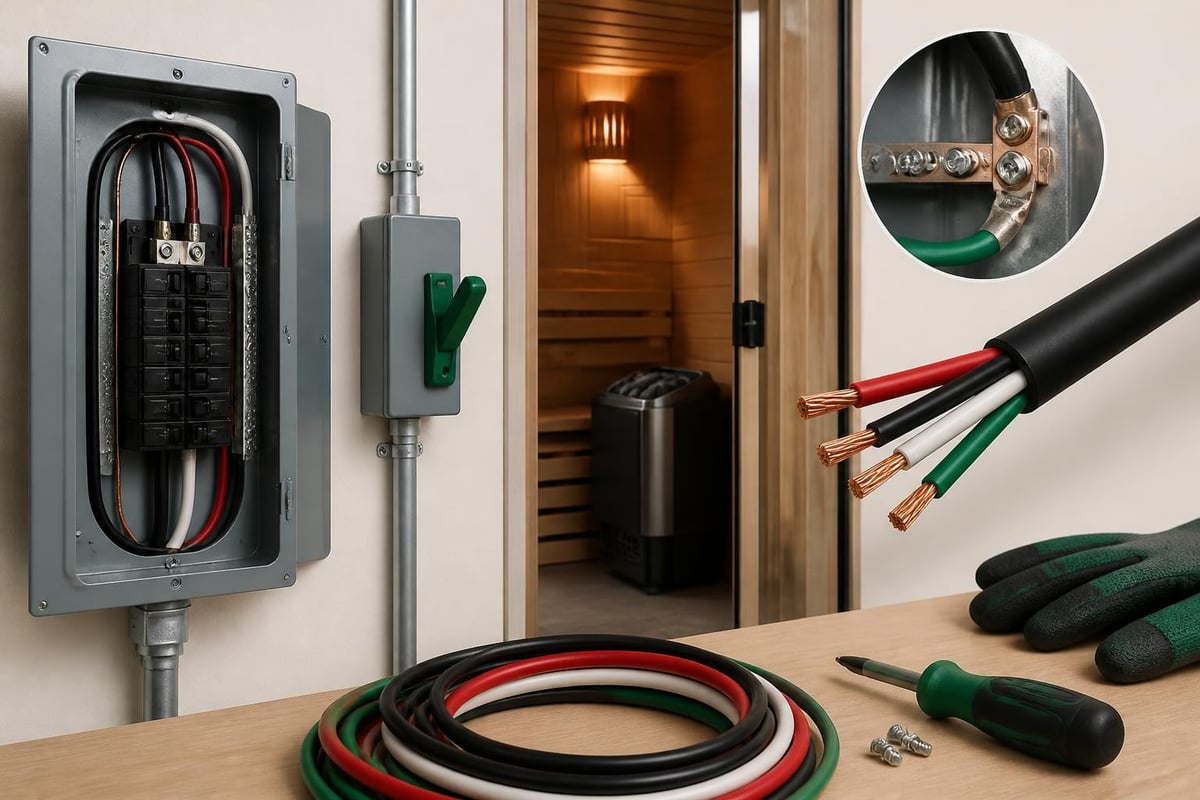
An electric sauna is typically operational within a day of delivery, assuming the electrical circuit is ready. A licensed electrician runs a dedicated 240-volt line from your panel to the sauna, installs a disconnect switch and connects the heater terminals. Total electrical labor usually ranges from four to eight hours, depending on distance and local code requirements.
Wood-burning installations require foundation reinforcement for the stove's weight, masonry or pre-fabricated chimney assembly, roof flashing, spark arrestor and annual chimney cleaning. Those added steps can delay your first sauna session by several weeks and add $2,000 to $5,000 to project costs.
Sizing Your Electric Sauna Heater
Heater output, measured in kilowatts (kW), must match your sauna's interior volume and insulation quality. Undersized heaters struggle to reach 80°C (176°F) in winter; oversized units cycle on and off too frequently, reducing rock longevity and wasting energy.
Calculating the Right kW Output
The standard sizing formula is 1 kW per cubic meter of interior space for well-insulated outdoor saunas. Add 20 percent if your sauna has large glass areas, minimal insulation or sits in a climate with winter lows below -20°C (-4°F).
| Interior Volume | Base kW | Cold Climate kW | Typical Models |
|---|---|---|---|
| 4–6 m³ | 4.5 kW | 6 kW | 2-person outdoor sauna |
| 7–9 m³ | 6 kW | 8 kW | 4-person sauna |
| 10–12 m³ | 8 kW | 9 kW | 6-person sauna |
| 13–15 m³ | 9 kW | 10.5 kW | Large family sauna |
To calculate your sauna's volume, measure interior width × depth × average ceiling height. For example, a sauna 2.3 m wide, 2.3 m deep and 2.0 m tall has 10.6 m³ volume and needs an 8 kW or 9 kW heater.
Electrical Service Limitations
Electric sauna heaters draw significant amperage. A 6 kW heater requires a 30-amp circuit; a 9 kW heater needs 40 amps. Before selecting a heater, confirm your home's electrical panel has available capacity. Older homes with 100-amp service may require a panel upgrade to accommodate a high-output sauna heater alongside existing appliances.
Consult your electrician early. Panel upgrades add $1,500 to $3,000 but are often necessary and improve home resale value.
Electric vs. Wood-Burning Heat: Performance Trade-Offs
Both heating methods deliver authentic sauna bathing, but they differ in operating rhythm, cost structure and the quality of löyly (steam).
Heat-Up Time and Temperature Control
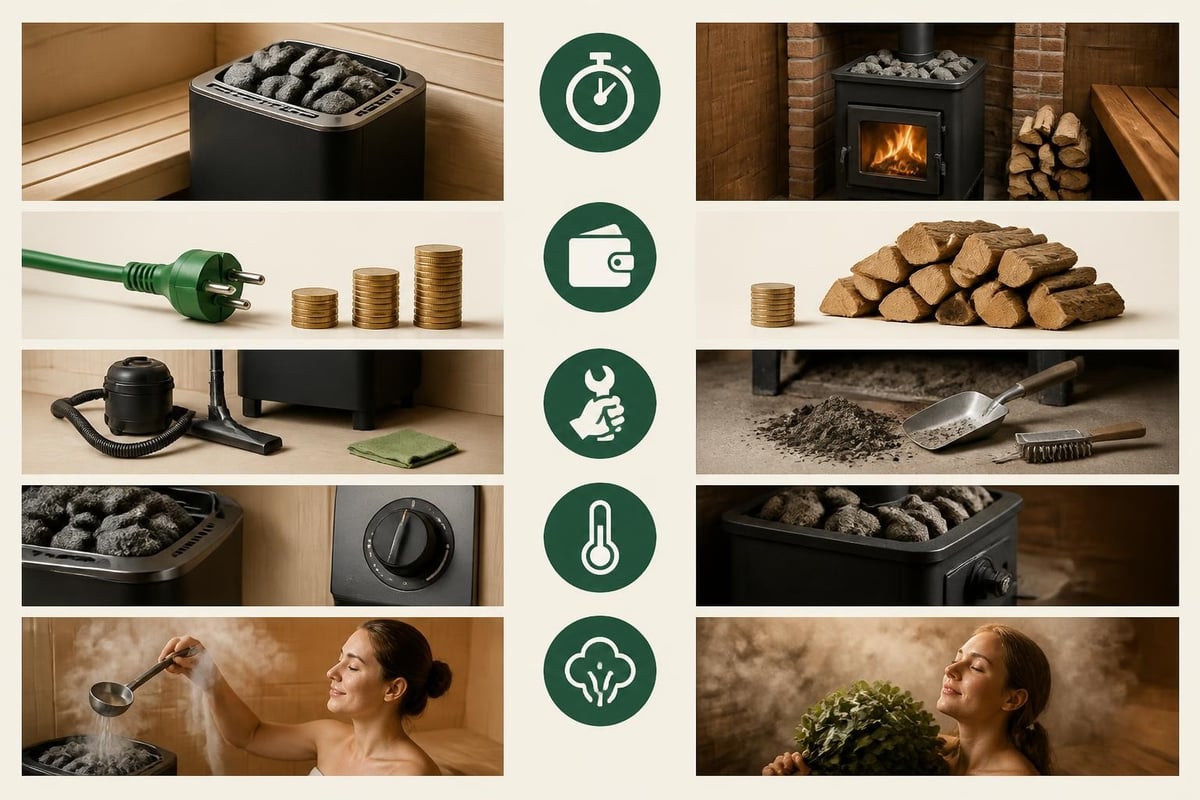
An electric sauna reaches target temperature in 30 to 45 minutes with precise thermostat control. You set the desired temperature, and the heater maintains it automatically. This predictability suits busy households and families who sauna on a schedule.
Wood-burning heaters take 45 to 90 minutes to reach temperature and require constant fire tending. The payoff is higher rock mass and thermal inertia. A well-loaded wood stove holds heat longer and produces what many Finnish sauna enthusiasts describe as a softer, more enveloping löyly.
Electric advantages:
- Set-and-forget operation with digital controls
- No wood splitting, hauling or ash disposal
- Faster heat-up for spontaneous sauna sessions
- Consistent temperature across multiple bathing rounds
Wood-burning advantages:
- Higher peak rock temperature (often 20–30°C hotter)
- Longer heat retention between fires
- Crackling fire and wood smoke create a multisensory ritual
- No electrical operating cost
If you value convenience and live in an area with restrictive air-quality rules, electric heat is the practical choice. If you have ample firewood supply, enjoy the ritual of fire-building and want maximum heat mass, a wood stove delivers a traditional experience.
Electrical Installation Requirements
Installing an electric sauna heater is straightforward work for a licensed electrician, but homeowners should understand the process to budget accurately and coordinate timing with sauna delivery.
Circuit Specifications and Wire Sizing
Electric sauna heaters require a dedicated 240-volt circuit. The wire gauge and breaker size depend on heater output:
| Heater kW | Circuit Amps | Wire Gauge (Copper) | Breaker Size |
|---|---|---|---|
| 4.5 kW | 25 A | 10 AWG | 30 A |
| 6 kW | 30 A | 10 AWG | 40 A |
| 8 kW | 40 A | 8 AWG | 50 A |
| 9 kW | 45 A | 8 AWG | 60 A |
Wire runs longer than 30 meters may require larger gauge to minimize voltage drop. Your electrician will calculate this based on actual distance from the panel to the sauna.
Disconnect Switch and Exterior Wiring
Code requires a weatherproof disconnect switch mounted within sight of the sauna, allowing you to cut power for maintenance or emergencies. The switch must be rated for the heater's amperage and installed in a NEMA-rated exterior enclosure.
Wiring from the house to an outdoor sauna typically uses underground conduit (UF-B cable in PVC conduit buried 45 cm deep) or overhead aerial cable on insulated supports. Underground installation is cleaner visually and less vulnerable to weather damage but adds trenching labor.
Budget $800 to $1,800 for a complete electrical installation, depending on distance, local labor rates and whether trenching is required. Always hire a licensed electrician; improper sauna wiring is a serious fire and shock hazard.
Operating Costs and Energy Efficiency
Electric sauna operating costs depend on heater size, session frequency, local electricity rates and preheating duration.
Calculating Cost per Session
A typical sauna session consumes energy during the 30 to 45-minute preheat phase and maintains temperature for 60 to 90 minutes of bathing. Total runtime averages two hours.
An 8 kW heater running for two hours consumes 16 kWh. At the 2026 average U.S. residential electricity rate of $0.16 per kWh, one session costs $2.56. Canadian rates average $0.13 per kWh (CAD), yielding a $2.08 session cost.
Monthly cost estimates (three sessions per week):
- 6 kW heater: $22–$28 per month (USA) / $18–$23 (Canada)
- 8 kW heater: $30–$38 per month (USA) / $24–$31 (Canada)
- 9 kW heater: $34–$43 per month (USA) / $27–$35 (Canada)
These figures assume moderate insulation and outdoor temperatures between -10°C and 25°C. Poorly insulated saunas or extreme cold can increase costs by 20 to 30 percent.
Reducing Energy Consumption
Well-insulated walls, a tight-fitting door and a properly sized heater minimize wasted energy. Thermowood and Nordic Pine saunas with 46 mm solid-wood walls retain heat efficiently without additional vapor barriers or fiberglass insulation.
Energy-saving practices:
- Preheat only as long as necessary (test your sauna's minimum warm-up time)
- Use a timer to avoid accidental overnight heating
- Close vents during preheat, open during bathing for fresh air
- Keep the door closed between bathing rounds
Some buyers install a smart thermostat or Wi-Fi controller, allowing remote preheat 45 minutes before arriving home. This convenience avoids the temptation to leave the heater on all day.
Choosing Between Electric and Wood Heat for Your Backyard Sauna
The decision often comes down to property layout, local regulations, available budget and your personal sauna ritual preferences.
When Electric Heat Makes Sense
Electric sauna heaters are the best choice if you face any of these conditions:
- Municipal wood-burning restrictions or air-quality ordinances
- Limited outdoor space (no room for wood storage or chimney clearance)
- Preference for predictable, thermostat-controlled heat
- Desire for fastest installation and lowest upfront cost
- Uncertain about long-term firewood supply or storage
Electric heat also suits buyers who plan to sauna frequently on weeknights after work. The ability to preheat remotely and step into a ready sauna within 40 minutes aligns with busy North American schedules.
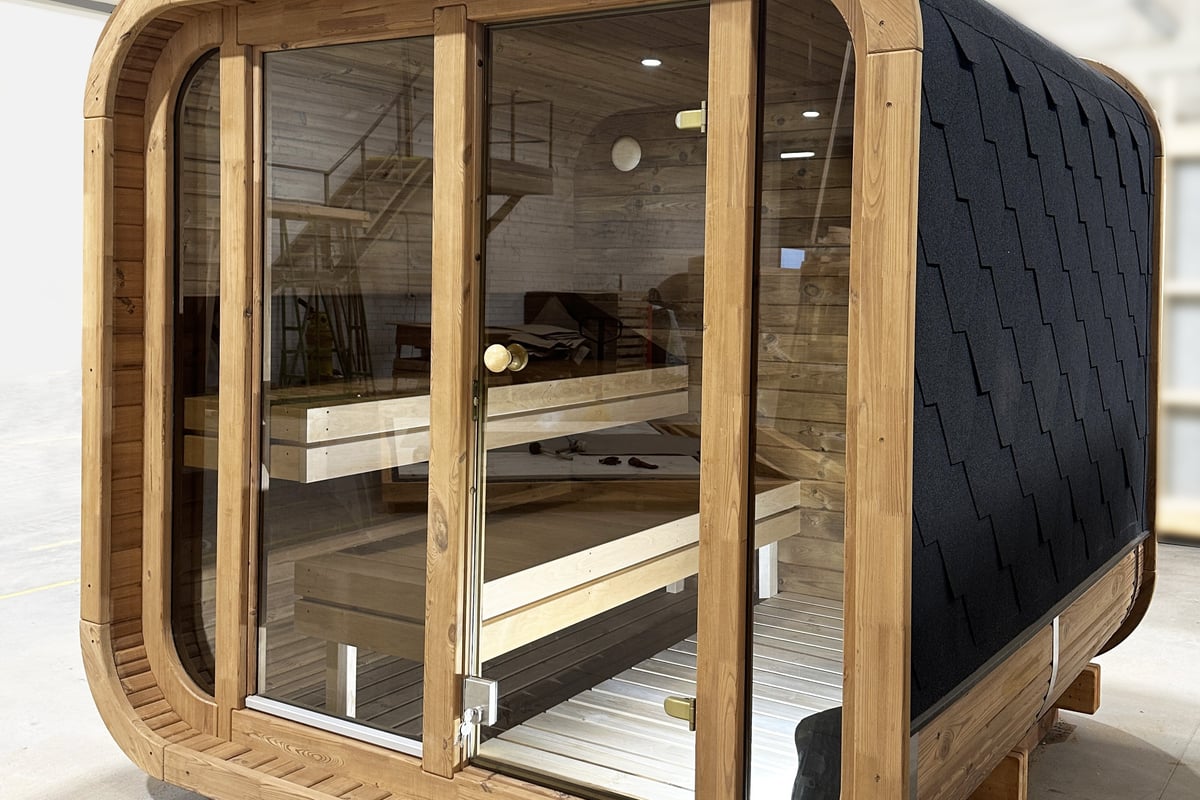
For homeowners installing a compact outdoor sauna, such as the RecoSauna Sisu Square Sauna 2.3 × 2.3 m in Thermowood, electric heating keeps installation simple and the footprint minimal. This model accommodates two to six people with a straight Black Alder or Aspen bench and accepts any UL-listed sauna heater sized appropriately for its interior volume.
When Wood-Burning Heat Is Worth the Investment
Wood-burning stoves deliver superior heat mass, longer sessions between firings and the crackling ambiance that many sauna purists prefer. Choose wood heat if you:
- Have ready access to seasoned firewood (ideally hardwood)
- Enjoy fire-tending as part of the sauna ritual
- Plan to host extended sauna gatherings (three-plus hours)
- Live in a rural area with no air-quality restrictions
- Want to sauna off-grid or during power outages
Wood heat requires a larger foundation to support the stove's weight, annual chimney inspection and higher upfront installation costs. The trade-off is zero electrical operating cost and a traditional Finnish sauna experience.
Ventilation and Air Quality in Electric Saunas
Proper ventilation ensures fresh air circulation, oxygen replenishment and moisture control. Electric saunas, like wood-burning models, require intake and exhaust vents positioned to create natural convection.
Standard Ventilation Layout
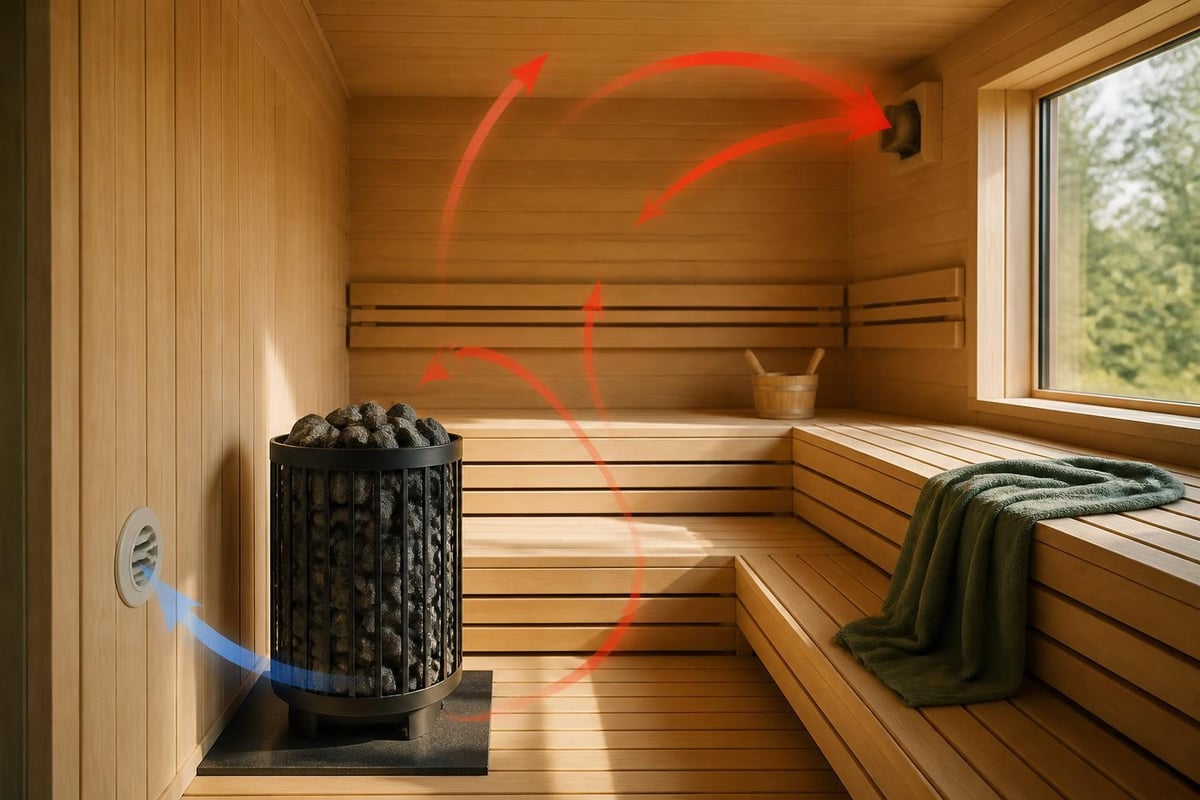
A well-designed sauna has a fresh-air intake near the floor, close to the heater, and an exhaust vent near the ceiling on the opposite wall or above the door. This arrangement draws cool air across the heater, where it warms and rises, then exits through the upper vent after circulating around bathers.
Recommended vent sizing:
- Intake vent: 50–100 cm² per cubic meter of sauna volume
- Exhaust vent: 100–150 cm² per cubic meter (slightly larger than intake)
Adjustable vents let you fine-tune airflow. Close vents during preheat to speed warm-up; open them during bathing to refresh the air every few minutes. Good ventilation also prevents mold growth and wood degradation between sessions.
The ASHRAE Handbook chapter on room air distribution offers authoritative guidance on ventilation principles applicable to enclosed heated spaces, including saunas.
Managing Humidity and Moisture
Electric heaters themselves produce no moisture. All humidity comes from water you ladle onto the rocks (löyly). In Finnish sauna tradition, löyly raises relative humidity briefly to 10 to 20 percent, creating the enveloping steam that defines authentic sauna bathing.
After each session, open the door and vents fully to release moisture. Leave the heater off and let the sauna air-dry for 30 to 60 minutes. Thermowood naturally resists moisture and decay, but proper ventilation extends the life of benches, walls and flooring.
Safety Considerations and Best Practices
Electric saunas are very safe when installed and operated correctly. Following a few common-sense precautions protects both bathers and equipment.
Heater Guards and Rock Placement
All sauna heaters ship with protective guards that prevent accidental contact with hot surfaces and heating elements. Never remove these guards. Sauna rocks should fill the heater's rock chamber completely, covering elements while allowing airflow between stones.
Replace cracked or crumbling rocks annually. Broken rocks reduce heat retention and can obstruct airflow, causing the heater's thermal cutoff to trip.
Bather Health and Hydration
Systematic research on sauna bathing shows cardiovascular and immune benefits for healthy adults who sauna regularly. However, sauna bathing is not suitable for everyone.
Individuals who should avoid saunas or consult a physician first:
- Pregnant women
- People with unstable angina, recent heart attack or severe aortic stenosis
- Children under six (always supervise children six to twelve)
- Anyone under the influence of alcohol or sedatives
Dehydration is the most common sauna-related issue. Drink water before, during and after each session. If you feel dizzy, nauseous or uncomfortable, exit immediately and cool down.
Timer and Automatic Shutoff
Install a timer or use the heater's built-in shutoff feature to prevent accidental all-day heating. Most modern electric sauna heaters include a four- or eight-hour automatic shutoff. Set the timer for your expected session length plus 30 minutes of margin.
Never leave the sauna unattended while the heater is on. The Finnish Sauna Society emphasizes that sauna safety begins with attentive, informed use and proper installation.
Maintenance and Heater Longevity
Electric sauna heaters are low-maintenance appliances, but a few routine tasks keep them running efficiently for 15 to 20 years.
Annual Inspection Checklist
- Inspect sauna rocks – Replace cracked or disintegrated stones. Top up the rock chamber if the level has dropped.
- Check electrical connections – Confirm terminals are tight and wires show no signs of overheating or corrosion.
- Clean heating elements – Vacuum dust and mineral deposits from elements using a soft brush (heater must be off and cool).
- Test thermostat and sensors – Verify accurate temperature readings and consistent heating cycles.
- Examine door seals and hinges – Tighten loose hardware; replace worn weather stripping.
Many homeowners schedule this inspection in early spring, before peak sauna season begins.
Heater Replacement and Upgrades
When a heater eventually fails (usually due to element burnout), replacement is straightforward. Modern heaters mount to the same footprint and connect to the existing circuit. Upgrading to a higher-output model may require rewiring to a larger breaker and heavier gauge wire.
Heater costs range from $400 for basic 4.5 kW units to $1,200 for premium 9 kW models with digital controls and remote start capability. Professional installation adds $200 to $400.
Integration with Smart Home and Remote Controls
Many 2026-model electric sauna heaters offer Wi-Fi connectivity, smartphone apps and integration with home automation platforms. These features add convenience but are not essential for a great sauna experience.
Remote Preheat and Scheduling
Wi-Fi-enabled heaters let you start preheating from your phone, ensuring the sauna is ready when you arrive home. You can also schedule recurring sessions (e.g., every Tuesday and Friday at 6 PM) and receive notifications when target temperature is reached.
Smart controls typically add $150 to $300 to heater cost. Evaluate whether the convenience justifies the expense based on your sauna routine. Families who sauna on a fixed schedule may prefer a simple mechanical timer.
Energy Monitoring and Usage Tracking
Some smart heaters report real-time energy consumption and monthly usage statistics. This data helps you optimize preheat time, identify inefficient operation and track operating costs accurately.
For most buyers, basic on/off control and a mechanical timer meet all practical needs. Advanced features are nice-to-have, not must-have.
Pairing Your Electric Sauna with Cold Plunge
Finnish sauna culture traditionally includes cold-water immersion between sauna rounds. The contrast between hot and cold enhances circulation, mental clarity and the overall wellness experience.
Locating a Cold Plunge Near Your Sauna
Position a cold plunge, stock tank or natural water source within 5 to 10 meters of your sauna. This short distance lets you move quickly between hot and cold without excessive heat loss or discomfort.
Many North American homeowners use insulated cold-plunge tubs, which maintain water temperature year-round and require minimal maintenance. Alternatively, a simple outdoor shower delivers a cold rinse between sauna rounds.
Safe Transition Practices
The sauna-to-cold-plunge transition is invigorating but demands caution. Cool down for 30 to 60 seconds in fresh air before plunging. Enter the water gradually, starting with feet and legs. Exit immediately if you experience chest pain, shortness of breath or dizziness.
Current sauna research from the University of Eastern Finland suggests that regular sauna bathing, often combined with cold exposure, may support immune and cardiovascular health, though individual results vary.
Long-Term Value and Resale Considerations
A well-built outdoor electric sauna adds functional square footage, wellness amenity and visual appeal to your property. Buyers in health-conscious markets increasingly seek homes with dedicated sauna and cold-plunge setups.
Sauna as a Property Differentiator
Real estate agents report that outdoor saunas help homes stand out in competitive markets, particularly in the Pacific Northwest, Mountain West and upper Midwest regions where sauna culture is growing. A premium Thermowood sauna with electric heat is easier to market than a wood-burning model because it appeals to a broader buyer pool (no wood storage or chimney maintenance required).
Expect a quality outdoor sauna to contribute 40 to 60 percent of its installed cost to home resale value, depending on local market conditions and buyer demographics.
Material Durability and Aesthetic Aging
Thermowood and Nordic Pine age beautifully outdoors, developing a silver-gray patina if left untreated or retaining their original color with periodic oil application. Both materials resist rot, insect damage and warping far better than pressure-treated softwoods.
An electric sauna with solid-wood construction, proper ventilation and routine maintenance will deliver 20-plus years of reliable service. By contrast, lower-cost saunas built with thin panels, inadequate insulation or substandard heaters often require major repairs or replacement within a decade.
An electric sauna brings authentic Finnish wellness into your backyard with predictable heat, code-compliant installation and minimal ongoing maintenance. Matching heater output to your sauna's volume, ensuring proper electrical service and planning for ventilation will set you up for years of satisfying sauna sessions. RecoSauna offers a curated selection of Thermowood and Nordic Pine outdoor saunas designed for North American climates, complete with practical guidance on heater selection, foundation prep and year-round operation. Explore the collection and start planning your backyard sauna retreat today.
Share:
Sauna Flex: Stretching, Mobility & Warm-Up Guide 2026
Sauna Bag: Uses, Materials & What Buyers Should Know